
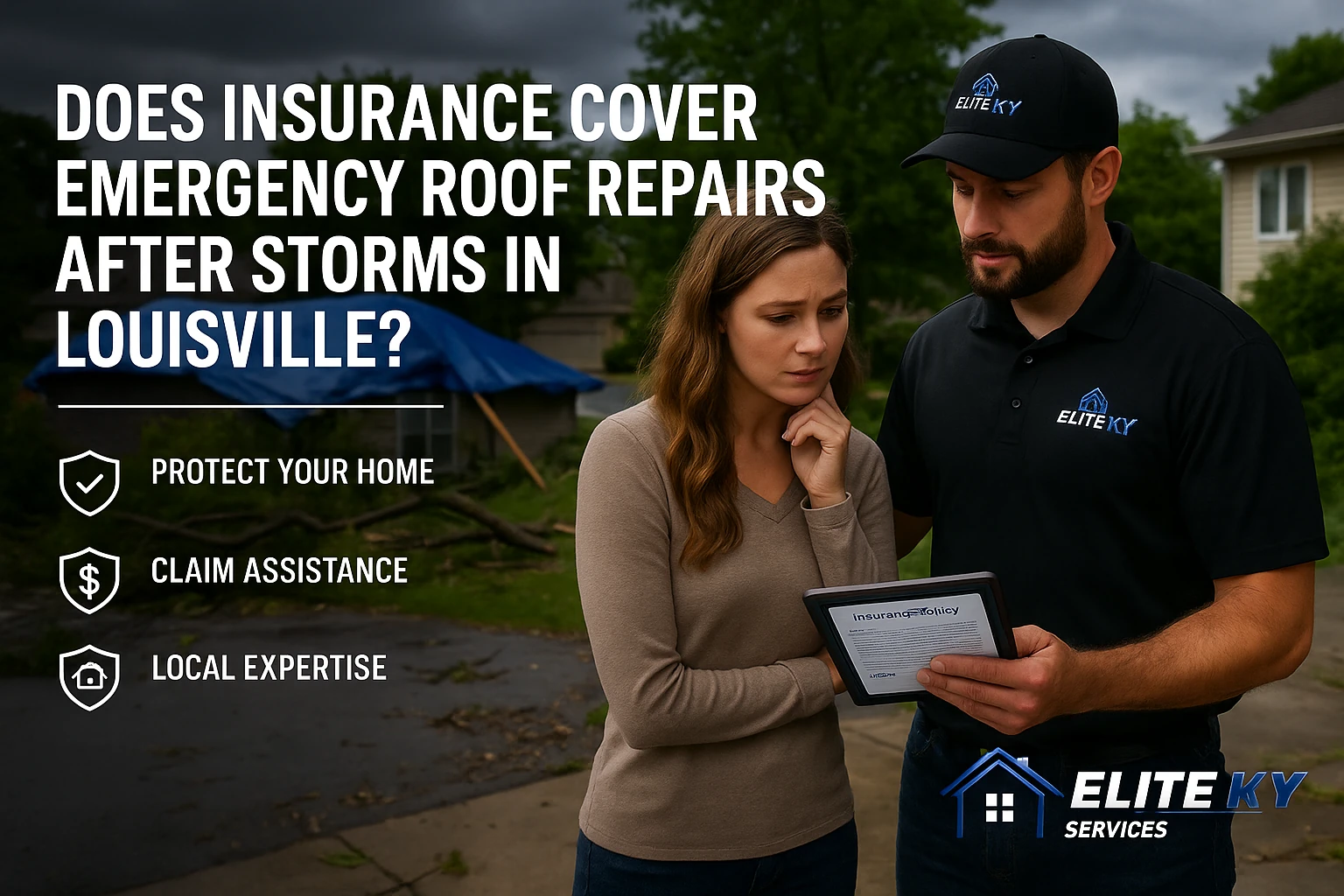
What to know about insurance cover emergency roof
Living on the border of Kentucky and Southern Indiana places your home at the mercy of volatile weather systems that do not respect city lines. A severe storm can drop hail across Jefferson County, sweep high winds through suburban Southern Indiana, or unleash heavy rains that turn driveways into rivers within hours. When such an event occurs, many homeowners immediately face a dual crisis: stopping active water intrusion to prevent structural decay and determining exactly how much of the repair bill their insurance policy will actually pay for.
The most common question arising during this stressful window is not “who should I call?” but rather, “does my insurance cover emergency roof repairs?” The short answer involves nuances regarding your specific policy language, the cause of the damage, and the immediate actions you take to mitigate further harm. This guide aims to provide honest clarity for property owners in Louisville Metro, surrounding Kentucky communities, and Southern Indiana regions who are navigating these claims processes with Elite KY Services & Construction at their side.
Understanding your coverage before a disaster strikes is ideal, but when the storm has passed and water is dripping from your ceilings or wind has lifted shingles near you, time becomes your most critical resource. Insurance companies operate on strict definitions of “covered peril” versus “maintenance exclusions.” They differentiate sharply between damage caused by sudden accidents—like being struck by a tree branch during a thunderstorm—and gradual issues like cracked sealants that have simply aged over years. This distinction often determines whether you face significant out-of-pocket costs or receive the full settlement needed for restoration.
Elite KY Services & Construction serves as your calm partner in this chaos. We understand the local insurance landscape, from Louisville’s specific carriers to those serving Southern Indiana border towns. While we cannot dictate what a third-party insurer pays on their end, our role is vital: we document damage accurately so you do not undervalue your claim, and we handle emergency roofing services by ensuring that temporary fixes are documented as part of the larger scope of work rather than ignored costs you must absorb alone.
If you have experienced sudden weather events—hail, wind storms, or rapid temperature swings—and suspect damage to your roof structure, there is a clear path forward. This article breaks down how Kentucky homeowners policies typically function during these moments and explains why engaging an expert roofer immediately can actually help secure higher coverage limits for your claim later on.
Understanding Your Kentucky Homeowners Policy Basics
Before you file that first call or sign off on any estimates, it is essential to grasp the fundamental architecture of a standard HO-3 (Homeowners 3) policy, which protects the vast majority of single-family homes in our region. Coverage under these policies generally splits into two distinct buckets: “dwelling coverage” for the structure itself and other structures or personal property inside your home. For emergency roof repairs specifically, you are looking at how much insurance money is applied to Coverage A (your dwelling).
Sudden Events vs. Gradual Wear
The most frequent point of confusion lies in the difference between “sudden and accidental” damage versus gradual wear and tear. Most standard policies will happily cover a scenario where a tree falls onto your house due to high winds or hail cracks shingles on the windward side during a storm event. In these instances, does insurance pay for storm damage roof repair KY becomes irrelevant because the cause is explicitly listed as covered in almost every policy form.
However, insurers often deny claims when they argue that moisture penetration was caused by long-term aging materials or pre-existing cracks rather than an active weather event occurring now. For example, if a shingle curls up over ten years due to sun exposure and allows water inside during the next rainstorm without any new wind damage nearby, insurance may view this as maintenance. To be clear on whether insurance covers emergency roof repairs in Louisville, you must prove that there was an active peril at work when the leak started or developed.
If high winds lift a section of your composition shingle and expose the decking underneath to driving rain just days after the storm hit, that damage is sudden and accidental. If the same wind event happens but simply reveals a crack in flashing you had for five years, the claim gets tricky. Elite KY Services & Construction helps bridge this gap by performing thorough inspections that document new versus old damage, preventing claims from being denied based on misinterpretation of pre-existing conditions.
The Deductible Reality Check
A significant financial hurdle many homeowners face is the deductible. Even when an insurer approves you for emergency roofing service after a hail storm or high wind event directly, as often happens with coverage issues in Louisville, your policy’s deductible almost always applies to roof repairs unless it qualifies under certain specific state endorsements (which are not universal in Kentucky).
Many property owners incorrectly believe that because their insurance “pays” for the bill after a hurricane, they pay nothing. This is rarely true. You are responsible for paying your deductible first before receiving any settlement check or credit toward repair costs. Whether it is $500 or 1% of your dwelling coverage limit (often called the wind/rain deductibles in storm-prone areas), you must budget for this out-of-pocket expense upfront unless you have a low-deductible endorsement that specifically waives them after certain thresholds are met.
For those asking, “will my deductible apply if my insurer approves me for an emergency roofing service after a hail storm or high wind event?”, the answer remains consistent across most standard Kentucky policies: yes, deductibles generally apply even when coverage is triggered by a named peril like hail. However, there are scenarios where you might avoid paying it entirely, such as using “Loss of Use” coverage if your home becomes uninhabitable due to water intrusion preventing repairs.
Immediate Steps to File Your Emergency Claim
Speed matters significantly in the insurance claims process, particularly regarding water intrusion limits imposed by your insurer’s mitigation clauses. Most policies explicitly state that if wind or hail damages part of your home but you take no action within 48 hours to mitigate damage—meaning stop leaks and prevent rot from spreading—the insurer may only pay for what is reasonable under their policy.
Mitigation Is Mandatory
When a storm hits or if high winds tear off your shingles in Louisville or Southern Indiana areas immediately after such an event, you have a duty to protect your property from further deterioration. This is known as “mitigation.” Failing to stop water intrusion can lead to denied claims on anything beyond the initial hole caused by debris.
You must act immediately when you suspect your roof has been compromised. While waiting for an official adjuster appointment—which can take days or weeks depending on the volume of claims in Jefferson County—you should hire a reputable contractor, like Elite KY Services & Construction, to inspect and secure the property. We understand that every dollar spent now saves money later by preventing mold growth or structural rot.
The Tarp Question and Eligible Costs
A critical expense many homeowners fear is paying for temporary repairs before their claim settles out of pocket. Fortunately, standard Kentucky policies generally include coverage for “reasonable necessary” expenses to make a home safe after an insured peril occurs. This means Are temporary tarping costs considered eligible? In most cases, yes—as long as you can document that the tarps were placed immediately following wind or hail damage (or sudden water infiltration from leaking roofs) and they effectively covered exposed areas to prevent further decay until permanent repair work could begin.
Documenting Damage: Photo Evidence
When you are ready to talk through next steps, Schedule a free roof inspection.
For more detail on this topic, see Asphalt Shingle Roofing.
Insurance adjusters rely heavily on visual evidence when they cannot be present at the property within 48 hours post-storm. This brings us directly to how Elite KY Services & Construction helps document and photograph roof damage.
Cost Considerations: Repairs vs. Deductibles
Before calling anyone, ask yourself honestly whether the urgent roof leak repair cost exceeds your deductible amount significantly enough to warrant filing a claim immediately if you haven’t already done so after severe weather hit recently within past 24–72 hours timeframe window where mitigation deadlines often expire quickly unless filed for coverage purposes timely before insurer stops paying additional water loss claims due negligence from homeowner not taking action fast enough. Sometimes the math suggests it’s better to pay out-of-pocket small fixes rather than drop a claim that might raise premiums drastically next year.
FAQ
Does my Louisville home insurance policy automatically cover emergency roof repairs caused by sudden storms?
Your specific policy dictates this, usually covering wind and hail but excluding wear-and-tear. If your insurer argues the damage is due to maintenance issues pre-dating the storm, coverage may be denied for that portion.
What specific steps should I take immediately to file an emergency repair claim before the damage worsens?
Immediately mitigate water intrusion using tarps or roofing tape. Document all visible damage with photos and videos timestamped on your device. Contact your insurance provider as soon as possible to start the claims process, but do not wait for them to assign an adjuster if leaks are active.
Are temporary tarping costs considered eligible for reimbursement under a standard homeowners insurance plan in Kentucky?
Generally, yes—tarps used immediately after a covered peril (wind/hail) count as “reasonable necessary” mitigation expenses. Keep all receipts and photos of the tarped roof before removing them or proceeding to permanent repair.
Can Elite KY Services help document and photograph roof damage to support my insurance claim process effectively?
Yes, we can provide detailed documentation that highlights new storm-related versus pre-existing issues. Our reports are designed to assist your claims adjuster by clearly separating sudden accidental events from wear-and-tear exclusions.
Does coverage vary significantly between different Southern Indiana communities regarding sudden water infiltration from leaking roofs?
While the core policy language is often consistent, specific endorsements and local carrier practices might differ slightly depending on the region. It is vital to review your individual declarations page regardless of where you live in Kentucky or nearby areas.
Address happens to the portion of my repair bill if my policy denies the claim for wear-and-tear versus a specific… with a concrete owner, a tracked metric, and a weekly review. For Does insurance cover emergency roof repairs, Elite KY Services & Construction recommends proving one improvement in Louisville KY before scaling the rest of the plan.