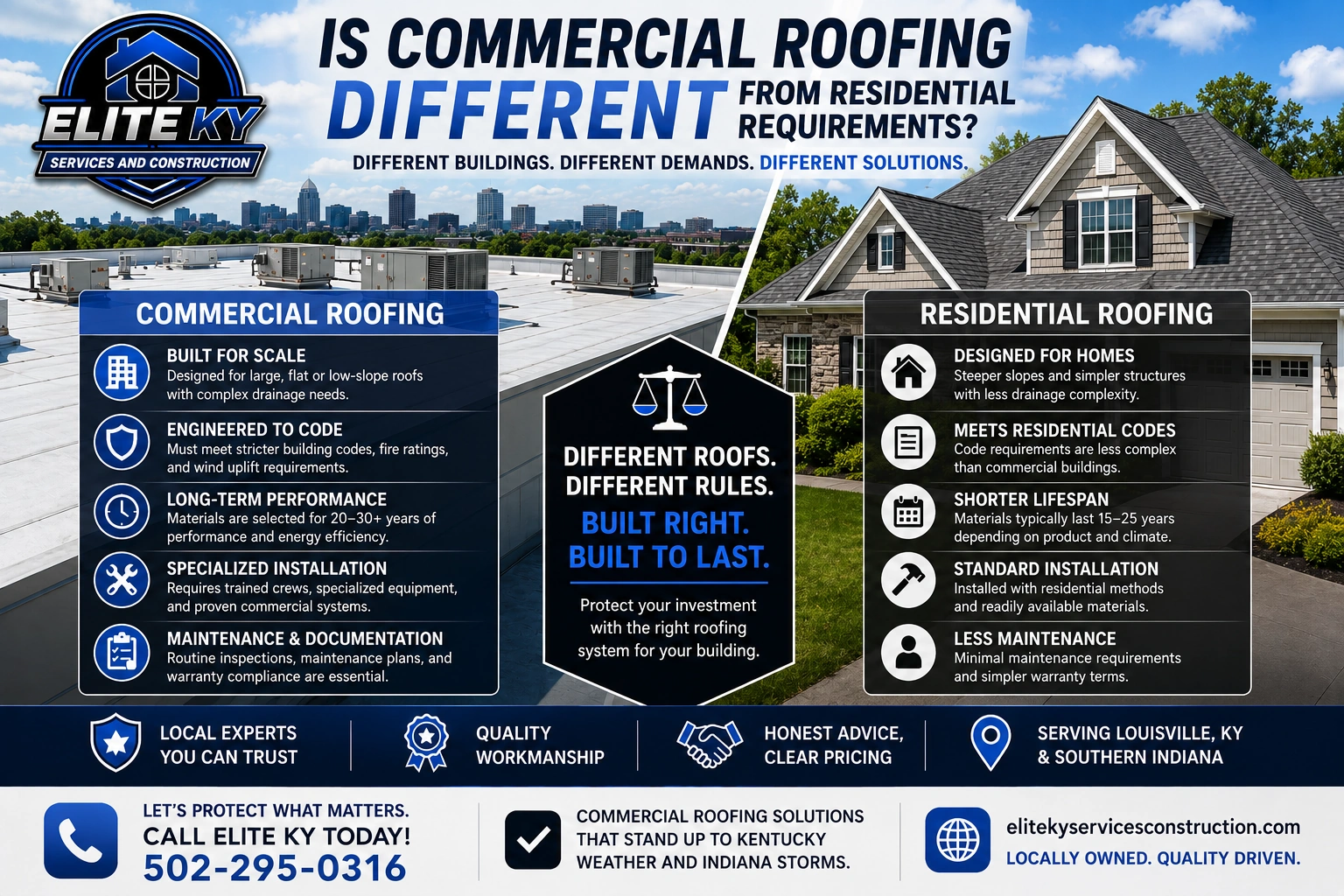
What to know about commercial vs residential roofing requirements Louisville KY
When a storm hits Louisville, Kentucky, or heavy rain drives through from Southern Indiana, every roof faces pressure. However, for many property owners managing small businesses, multi-unit rental complexes, or office buildings in the greater Louisville Metro area, there is often confusion about what makes their building distinct from a standard single-family home. While you can easily spot the difference between two houses on a residential street, understanding why commercial vs residential roofing requirements Louisville KY dictate different solutions requires looking beneath the surface at engineering standards, material lifespans, and local climate impacts.
At Elite KY Services & Construction, we deal with the day-in-and-day-out reality of exterior construction across Kentucky and Indiana borders. We have seen property owners attempt to apply “homeowner logic” to commercial properties—thinking that because a shingle roof works for their personal residence, it might work just as well over a warehouse or retail storefront. This is where problems begin. The engineering demands on these two types of structures are fundamentally different, and mixing them up can lead to premature failure, voided warranties, and costly emergency repairs when the first major storm rolls through.
Understanding the Structural Divide: Flat vs. Sloped Designs
The most immediate visual difference you will notice between commercial and residential roofs is their design geometry. In Louisville, traditional homes typically feature steeply sloped “pitched” roofs covered in asphalt shingles or sometimes slate or metal tiles. These designs rely on gravity to shed water quickly as it hits the roof surface. The steeper the angle, the faster rain runs off, minimizing pooling.
In contrast, commercial flat roof vs shingle roof Louisville applications represent a completely different engineering challenge. Most commercial buildings in Kentucky utilize low-slope or flat roofing systems like TPO (Thermoplastic Polyolefin), EPDM rubber, modified bitumen, or metal standing seam panels. These materials do not rely on gravity to move water off the surface; instead, they depend entirely on a carefully engineered drainage system consisting of drains and scuppers.
This structural difference drives every other requirement associated with these roofs. A sloped residential roof can tolerate minor imperfections in material placement because water flows away rapidly. On a flat commercial roof, even a slight dip or membrane breach becomes a major liability almost immediately as standing water sits there until the next rain event. This “ponding” is one of the leading causes of leakage issues reported by property managers in our service area. If you are evaluating your options for a new project and want to recognize that why commercial roofing differs from residential in Kentucky starts with understanding this slope requirement, it is critical to preventing leaks before they start.
Material Selection and Longevity Realities
Material choice often creates the largest friction point between homeowners attempting DIY repairs or small business owners looking for quick fixes versus professional specifications. For your single-family home, you might choose architectural asphalt shingles available in hundreds of colors at a hardware store nearby. These are generally rated to last 20 to 30 years under Louisville’s climate conditions if maintained well.
However, selecting materials for difference between commercial and home roof specifications involves a much more rigorous vetting process dictated by building codes and the intended lifespan of the structure. Commercial roofing systems must be engineered to withstand significantly higher loads than residential equivalents without becoming prohibitively expensive immediately after installation. We use materials specifically formulated for these environments:
- TPO Systems: Known for their reflective properties, which help reduce cooling costs during our hot Kentucky summers, TPO membranes are flexible and resistant to UV degradation.
- Modified Bitumen: Often used on flat commercial roofs where extreme durability is required in high-traffic areas or parking lots with cars occasionally driving onto the roof surface (though this requires special design considerations).
- EPDM Rubber: Extremely durable rubberized roofing that offers excellent resistance to thermal shock from rapid temperature changes common near our southern Indiana border.
Using residential shingles on a commercial flat application is almost never a viable long-term strategy and often violates local building codes regarding wind uplift ratings for commercial buildings. KY regulations are stricter because they account not just for rain, but the high winds that frequently impact Western Kentucky regions during severe weather events. An honest assessment reveals that you need specialized materials to ensure your investment lasts decades rather than years; a residential contractor might say any material works, but relying on shortcuts can be risky since Elite KY Services & Construction prioritizes quality workmanship because we know a leaking commercial roof can shut down business operations and lead to significant liability issues for landlords and HOA boards alike.
The Code Compliance Environment in Louisville
One area that separates these sectors sharply is the regulatory framework they operate under, specifically regarding code compliance for new construction roofing KY cities. Residential renovations are often governed by homeowner association rules or county building codes which can be lenient on slope requirements if the house was built decades ago. However, commercial properties must adhere to strict International Building Code (IBC) standards adopted locally.
In Louisville and surrounding jurisdictions like Fort Thomas or New Albany across state lines, a commercial flat roof vs shingle roof in Louisville distinction is vital regarding fire ratings and wind resistance classifications required by insurance companies. If your building houses employees or the public in commercial areas such as downtown districts, sprinkler system requirements and specific roofing materials may be mandated to prevent the spread of fire through HVAC intakes located directly under membrane layers above ceiling tiles below ground floor level spaces used for equipment storage facilities within those structures—too complex designs involving multiple penetrations requiring specialized flashing details at all seams around chimneys or exhaust vents not found in typical home repairs.
These codes ensure that if a storm surge causes wind uplift forces exceeding 90 mph—a scenario experienced during severe tornado outbreaks common to our region—the roof does not simply detach like lightweight residential shingles might under less secure installations meant only for light-duty domestic applications rather than industrial-grade structures supporting large HVAC machinery or solar panel arrays.
Maintenance Schedules: A Case of Different Timelines
Property owners often complain that their commercial roofs seem to fail faster than expected, blaming the contractor when it is actually an issue with maintenance frequency based on climate impacts affecting both sectors differently over time periods measured annually rather than just seasonally intervals depending upon location specifics such as proximity to river valleys increasing humidity levels year-round throughout calendar quarters starting from winter months ending late summer seasons extending into fall harvest times. Each autumn month preceding snowfall warnings issued early December dates when temperatures drop below freezing conditions overnight every night causes thermal expansion and contraction cycles that damage older membranes more rapidly than new ones installed recently within the last few years.
FAQ
Is commercial roofing different from residential roofing requirements?
Yes, they differ significantly in geometry, material selection, and code compliance because commercial structures often utilize low-slope flat roofs that rely on engineered drainage rather than gravity. Residential homes typically use steeply pitched designs with asphalt shingles to shed water quickly, whereas commercial buildings must prevent ponding using TPO or EPDM membranes.
Is commercial roofing different from residential roofing requirements?
Commercial properties face stricter International Building Code (IBC) standards regarding wind uplift ratings and structural load capacities that single-family homes do not require. Attempting to apply homeowner logic or residential shingle materials to a warehouse or office building can lead to premature failure and voided warranties under Kentucky weather conditions.
Is commercial roofing different from residential roofing requirements?
The primary distinction lies in the engineering demands where flat roofs must manage standing water while pitched roofs handle rapid runoff efficiently. This fundamental difference means that maintenance schedules for small businesses must address membrane degradation from UV exposure differently than how homeowners care for their sloped tiles or shingles.
Is commercial roofing different from residential roofing requirements?
Local regulations in Louisville and areas near the Southern Indiana border enforce specific material lifespans for multi-unit complexes that exceed the simple ratings found on standard homeowner hardware store products. While a single-family home might tolerate minor installation imperfections due to water flow, even slight dips in a flat commercial roof create immediate liability through leaks.
What are the key material and code differences between commercial flat roofs and residential sloped roofing in Louisville?
Commercial systems utilize TPO, EPDM rubber, or modified bitumen designed for high thermal shock resistance, while residences rely on architectural asphalt shingles rated for 20 to 30 years of service. Commercial codes mandate rigorous vetting processes to ensure materials can withstand higher loads and severe winds common in Western Kentucky, unlike the more lenient rules often applied to older residential renovations.
How does Kentucky's specific climate impact maintenance schedules for small commercial buildings versus single-family homes?
Heavy rains from Southern Indiana combined with rapid temperature changes near our border necessitate frequent inspections of flat roof membranes to catch early breaches before standing water forms ponds. Homeowners generally face less urgent scheduling pressure regarding material lifespan unless they live in flood zones, but commercial managers must proactively address thermal degradation and ponding risks immediately after storm events.
When you are ready to talk through next steps, Schedule a free roof inspection.
For more detail on this topic, see Pillar page.
Industry context worth reviewing: Louisville Roofing Company – Louisville Roofers | Mr. Roof.